



What causes jowls?
Jowls form when the soft tissue of the mid-face loses its support and slides down past the jawline. Two things drive it, and most people have both.
Collagen and elastin decline. These are the proteins that give skin its firmness and skin elasticity. Production slows from the mid-twenties and the existing supply breaks down with age, so the skin no longer snaps back and gravity does the rest.
Facial volume descends. The fat pads that sit high in the cheek thin and drop. Weight that used to sit over the cheekbone ends up along the jaw.
Several things speed both up:
Genetics. Early jowls often run in families. If your parents developed them in their forties, you are more likely to.
Sun damage. UV exposure, from the sun or from tanning beds, breaks down collagen faster than ageing alone. It shows as fine lines and wrinkles long before it shows as jowls, and it is the single most modifiable cause.
Weight loss. As weight is gained the skin stretches. When it is lost quickly, the skin does not shrink back at the same rate, and what is left is loose.
Smoking. Nicotine restricts blood flow to the skin while the chemicals in smoke create collagen-destroying enzymes.
When jowls start, and what stage yours are at
Most people notice jowling between their late thirties and early fifties, but the age varies a great deal and some see the beginnings in their twenties.
Early. The jawline softens rather than sags. There is no visible fold, but the jawline contour is less defined, and it shows in photographs before it shows in the mirror.
Moderate. A visible descent either side of the chin, with the jawline interrupted. Skin quality is still reasonable.
Advanced. Pronounced folds, loose skin extending towards the neck, and the jawline no longer readable as a line.
The stage matters more than the cause when it comes to treatment. Early and moderate jowling responds well to non-surgical work. Advanced jowls with significant loose skin often do not, and that is worth knowing before you spend anything.

How to get rid of jowls
Sagging jowls can be treated without surgery, and for most people that is the right starting point.
Facial exercises are often suggested. They strengthen the muscles of the lower face, but there is no good evidence that they lift descended fat or tighten loose skin.
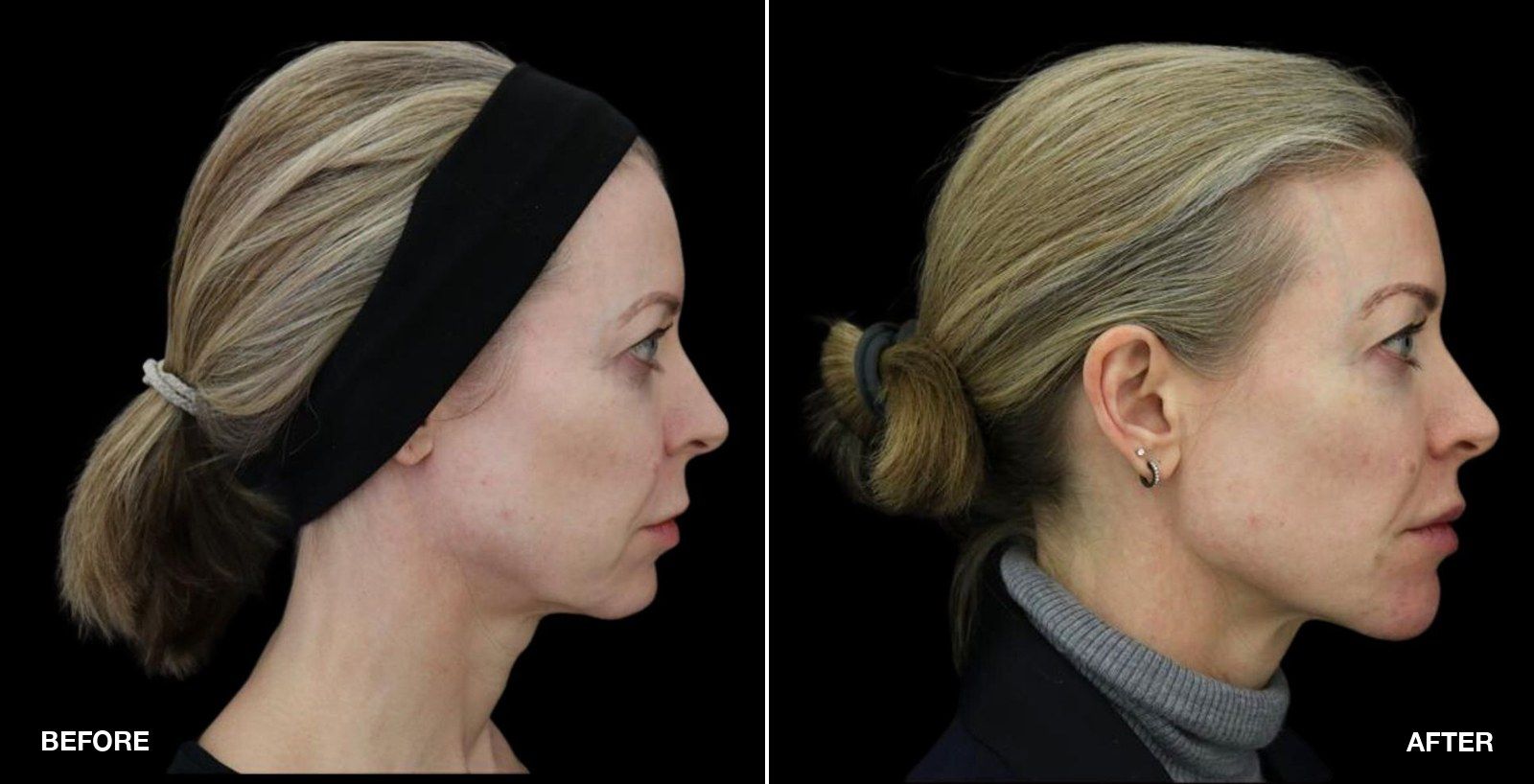
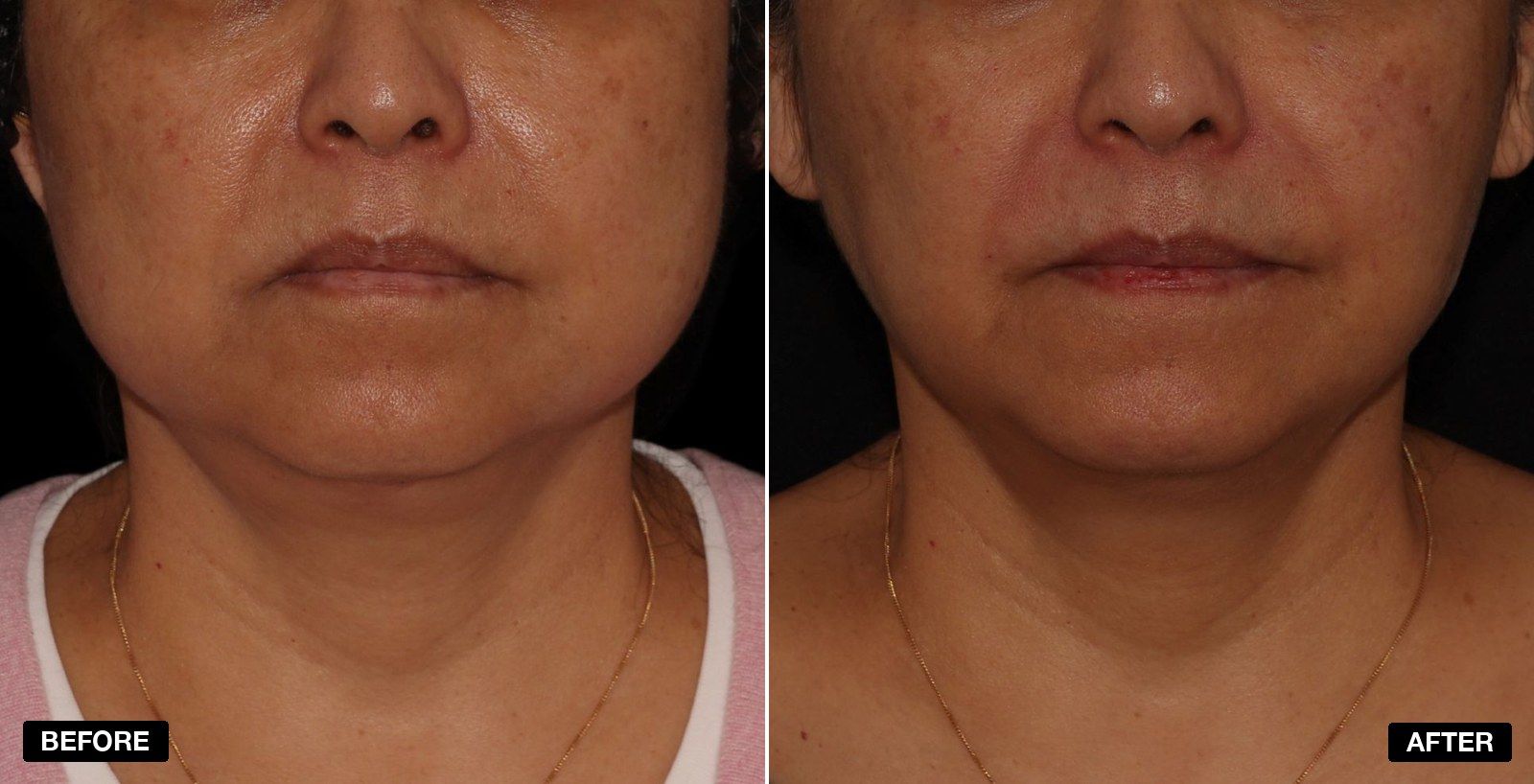
Our practitioners perform thousands of non-surgical treatments a year to reduce the appearance of jowls, using dermal fillers, Endolift, EMFACE and Ultraformer. Which suits you depends on whether the problem is lost volume or loose skin.
Sagging jowls before and after
Fillers for jowls
Filler does not fill the jowl. It rebuilds the structure above it, so the tissue that has descended is supported from higher in the face.
In an Aesthetic Surgery Journal study on hyaluronic acid filler for chin and jawline redefinition, 96.7% of patients described their appearance afterwards as "much improved" or "very much improved".
Jawline contouring with filler is precise work. Our specialist doctors and nurses use Juvéderm soft tissue dermal filler, and each injection is placed at a structural point along the jaw and mid-face to restore facial contours and reduce the appearance of jowls and, in some cases, a double chin. Chin filler is frequently part of the same plan, because the chin anchors the front of the jawline.
It is a non-surgical injectable treatment with minimal downtime, so you can return to normal activities the same day. Results last around 12 to 18 months.
Filler suits you if the jawline has lost definition but skin quality is still good. It suits you less well if the dominant problem is loose skin, where adding weight to tissue that cannot hold it makes the sag more obvious rather than less.
Skin tightening treatments
Where the problem is the skin rather than the volume beneath it, a device-based skin tightening treatment is the better route.
Endolift is minimally invasive, delivering laser energy beneath the skin through microscopic optical fibres to stimulate collagen production and tighten tissue from below without an incision. It also reduces small fat pockets along the jaw.
Ultraformer uses focused ultrasound to lift at a deeper level, reaching the supporting layer without breaking the surface of the skin.
EMFACE combines high-intensity facial electrical stimulation with radiofrequency, working on muscle tone as well as collagen and elastin.
All three work gradually rather than immediately, because they rely on your own collagen forming over the following weeks and months. That is normal, and it is worth knowing before you start, since people who expect a visible change within a fortnight tend to conclude a treatment has failed when it is in fact working.
What is the best non surgical treatment for jowls?
There is no single best treatment, because jowls are not a single problem.
If the jawline has softened but the skin is good, filler placed high restores the structure and does the most.
If the skin is the problem, tightening does more than any amount of volume.
If both, a combination, usually tightening first and volume second.
If the jowls are advanced with significant loose skin, non-surgical treatment will soften the appearance but it will not remove tissue. A surgical neck lift or facelift achieves what no injectable or device can. PHI Clinic performs only non-surgical treatments, and where surgery is the honest answer our practitioners will say so rather than treat and hope.
Where heaviness in the lower face is partly driven by an over-active masseter muscle, Botox in London can be combined with skin-tightening approaches.
Your dermal filler practitioners




Safe and effective treatment
Your safety is our priority at PHI Clinic. To ensure maximum standards of patient care, jowl treatments are only ever carried out by our experienced, highly qualified practitioners.
All our patients have a thorough consultation before having procedures with us and treatment is always carried out on a separate day. We believe it is essential for patients to be able to think before deciding whether to go ahead with any treatment.

Jowls frequently asked questions
Loss of collagen and elastin, combined with the descent of the fat pads in the cheek. Everything else, sun damage, smoking, weight loss and genetics, either accelerates those two or determines how early they start.
Usually the opposite. Losing weight removes volume from the face as well as the body, and where the skin has already lost elasticity it does not retract to match. Rapid weight loss is a common reason jowls appear or worsen. Gradual loss gives the skin more chance to keep up.
Almost always genetics. Bone structure, the position of the retaining ligaments and skin thickness are inherited, and some people simply have less support along the jawline from the start. Early jowls in your twenties are a structural feature rather than a sign of premature ageing, and they respond well to treatment because the skin quality is usually excellent.
Without surgery, by either rebuilding the support that has been lost with filler, or tightening the skin with laser or ultrasound, or both. Which applies depends on whether your jowls are driven by descended volume or by skin laxity.
Early and moderate jowls can be significantly improved. Ageing continues regardless, so treatment holds the line rather than stopping the clock, which is the argument for starting earlier rather than waiting for the problem to become advanced.
They strengthen the muscles of the lower face, which is not useless, but there is no reliable evidence that they lift descended fat or tighten loose skin. Treat claims about reversing jowls with exercise alone with scepticism.
Juvéderm dermal filler placed for jowls lasts around 12 to 18 months. Everyone metabolises filler differently, so it varies between patients, and your practitioner will review the result at a follow-up appointment before recommending a top-up.
From £400 for dermal fillers, £500 for EMFACE, £1,100 for Ultraformer and £2,000 for Endolift. A new patient consultation with a cosmetic doctor is from £125, and that is where the plan and the final cost are agreed.
Very little. All of our jowl treatments are non-surgical, so most patients return to normal activities the same day. Mild swelling or tenderness after filler is normal and settles within a few days.
Where there is a significant excess of loose skin, particularly extending into the neck. Non-surgical treatment tightens and supports, but it does not remove tissue. We will tell you at consultation if that is the position rather than sell you something that will disappoint you.
Location
PHI Clinic
102 Harley Street,
London,
W1G 7JB,
United Kingdom
Tel: 02070345999
Opening Hours
Monday & Tuesday - 9:30am to 6:00pm
Wednesday & Thursday - 9:30am to 8:00pm
Friday - 9:30am to 5:00pm
Saturday - 11:30am to 12:30pm
Sunday - Closed
Opening times can change, if your appointment is outside of these times please contact the clinic for confirmation.