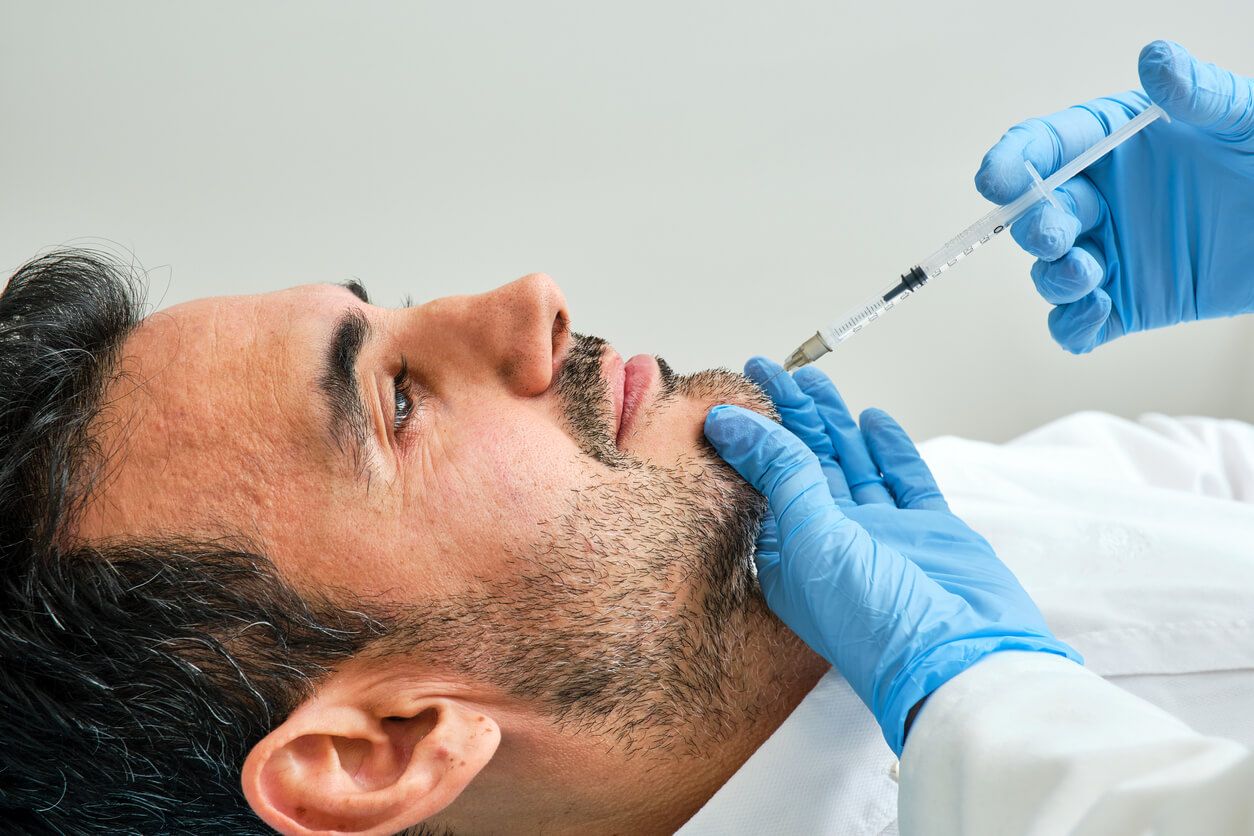
Understanding smile lines
Smile lines form through a combination of repeated movement and age-related change in the skin. Reduced collagen and elastin make the skin thinner, while the fat pads that used to sit high in the cheek descend, and the fold deepens as the tissue above it loses its support.
That second part matters more than most people realise. A nasolabial fold is often not a problem with the fold at all. It is the shadow cast by a cheek that has lost volume, which is why the most effective treatment is frequently not in the line itself.
For some people the lines appear only with expression. For others they stay visible at rest. The stage differs from person to person, which is why the treatment has to be decided in front of a mirror rather than from a photograph.
When filler is the right answer
Filler is likely to be the right choice if:
- The fold is clearly visible when your face is completely relaxed
- Volume loss in the cheeks has contributed to the depth of the fold
- You want a non-surgical option with an immediate result and minimal downtime
For these patients, dermal filler treatment in London softens the fold, lightens the midface and improves the transition from cheek to mouth. Most people describe the effect as looking rested rather than altered, which is the aim.
When something else is the better answer
Filler is not always the answer, and the honest cases where it is not are worth knowing.
If the line only appears on expression. Treating a dynamic fold with filler means adding volume to an area that does not need it yet, and it is the most common route to a face that looks heavier rather than fresher.
If the problem is skin quality rather than volume. Where the issue is fine texture, crepiness or pigmentation, skin boosters or laser resurfacing do more than filler will.
If the cheek is the real cause. Cheek filler placed to restore midface support often improves a nasolabial fold more convincingly than filling the fold directly, because it addresses the reason the fold deepened.
If you are at the earliest stage. Medical-grade skincare and sun protection genuinely slow the progression, and there is no advantage in starting injectable treatment before you need it.
What dermal fillers actually do here
Dermal fillers restore lost facial volume and soften folds by adding structure beneath the skin. Placed carefully, they provide a subtle lift and smooth the transition from cheek to nose and mouth.
At PHI Clinic we use premium hyaluronic acid fillers such as Juvéderm. These integrate with the surrounding tissue rather than sitting on top of it, which is what produces a natural lift with minimal swelling.
Product choice matters more in this area than in most. A softer gel suits a surface crease, while a firmer one is needed where the fold is deep or where the cheek is being supported. Using the wrong one is a common reason a result looks either underwhelming or obvious.
Every treatment for smile lines at our Harley Street clinic is carried out by an experienced practitioner, and the amount, the product and the placement are all decided at consultation rather than in advance.
What smile lines filler results look like, and how long they last
Most people notice an improvement immediately. The fold looks softened, the midface looks lighter, and the change is visible before you leave.
Mild redness, swelling or tenderness usually settles within a few days, and most people carry on with their normal routine the same day.
Results typically last nine to twelve months, though this varies with the product used, your skin health, your metabolism and how much movement there is in the area. A top-up appointment is usually how the result is maintained rather than starting again from scratch.
When smile line filler goes wrong
It is worth understanding what a poor result looks like, because it is almost always the same handful of causes.
Too much product. The most common one. An overfilled nasolabial area does not read as youthful, it reads as heavy, and it can make the lower face look fuller rather than lifted.
Filling the fold instead of the cause. Injecting directly into a deep crease without restoring the cheek above it can flatten the line while making the face look bottom-heavy. The fold improves; the face does not.
Placement too superficial. Hyaluronic acid placed too close to the surface can show as a bluish tinge or a visible ridge, particularly in thin skin.
Ignoring the anatomy. The angular artery runs close to the nasolabial fold, which makes this one of the areas where technique and anatomical knowledge matter most.
All of these are correctable, because hyaluronic acid can be dissolved with hyaluronidase. But the appointment you do not need is always cheaper than the one that fixes it.
What influences how long your result lasts
- Product selection. Softer fillers for surface creases, firmer gels for deep folds and structural support.
- How much movement is in the area. The mouth is mobile, so filler here does not last as long as filler placed over a cheekbone.
- Lifestyle. Smoking and heavy alcohol use accelerate the breakdown of hyaluronic acid, as does significant sun exposure.
- Aftercare. Avoiding alcohol, strenuous exercise and heat for 24 to 48 hours reduces redness, swelling and bruising.
Why the practitioner matters more than the product
Treating nasolabial folds well requires judgement as much as technique, because the decision about where to put the product is harder than the injection itself.
The practitioner has to work out whether the fold is the problem or the symptom, whether the cheek needs treating first, how much the area can carry, and whether you would be better served by not having filler at all this year.
At PHI Clinic, injectable treatments are carried out by practitioners with a breadth of experience in this area, and the priority is a result that still looks like your face.
Book a smile line consultation
If you are wondering whether filler is right for your smile lines, the first step is having someone look at them properly, in movement and at rest.
Our practitioners will assess your face as a whole, explain which option suits the stage you are at, and tell you honestly if the answer is that you do not need treatment yet.
Book your consultation at PHI Clinic on Harley Street to discuss smile line filler in London and what would actually suit you.