For more videos, follow PHI Clinic on Instagram @phiclinic
Filler Longevity: What Has Changed
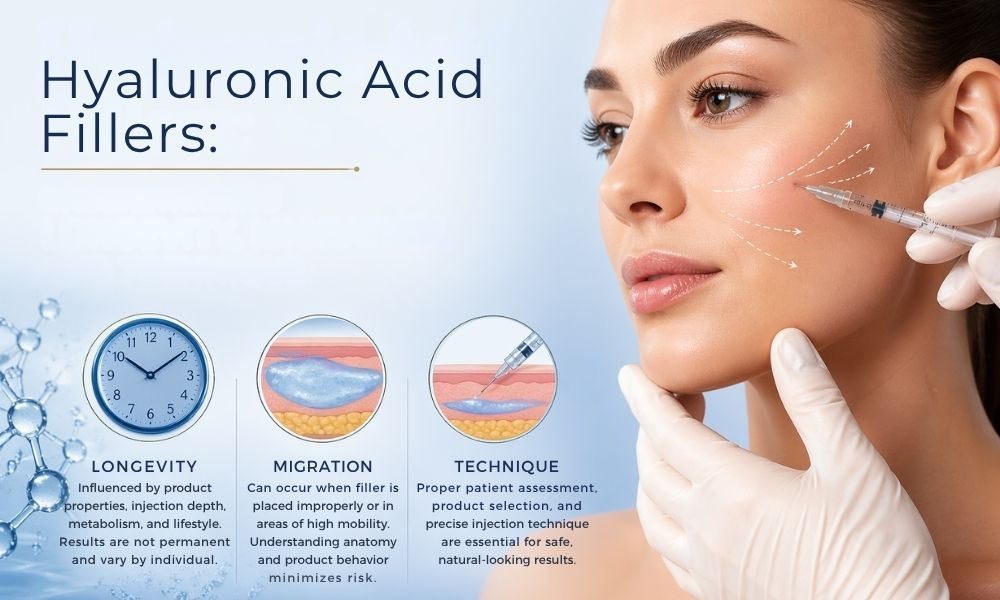
Many patients were originally told to think of filler as something relatively temporary. Newer imaging has complicated that picture. A 2024 review of 33 magnetic resonance imaging studies found hyaluronic acid filler in the mid-face still detectable after two years, with some evidence of persistence for considerably longer.
At first glance that sounds alarming. It is not.
As we explain in clinic:
"Longer lasting filler doesn't necessarily have to be scary. It just means we have to be a little bit more thoughtful about where we place it and how much we are putting in."
That is the important distinction. If filler remains in the tissue for longer than once assumed, then placement, product choice and quantity matter more rather than less. It does not make filler unsafe. It makes judgement more important.
The mid-face part matters too. Filler placed over a cheekbone sits in tissue that barely moves. Lips move constantly and have a generous blood supply, so they break product down considerably faster, which is why lip filler is replaced on a very different schedule from cheek or jaw filler.
So longevity is not a fixed timeframe. It is assessed individually, taking account of metabolism, treatment history and product choice, and informed by how your previous filler has actually behaved.
Filler Migration: What Patients Are Really Worried About
Migration can happen, and it needs to be understood properly. It does not mean filler travels around the face unpredictably. It means filler can move from where it was placed into a neighbouring area, usually when too much product has been used, the wrong product has been chosen, or it has been placed in the wrong layer.
As we explain in clinic:
"Migration can happen. Although it is uncommon, it can move from originally where it was put to another area of the face."
In the cheeks, cheek filler placed too superficially can move forward into the eye area. In the lips, product placed into the pink of the lip can move upward into the white lip.
These are not random outcomes. They are usually the result of poor injection technique, influenced by the treatment area, the product chosen and how the filler behaves after placement. Where a previous result has changed in an unexpected way, it can be assessed and, where appropriate, corrected. Hyaluronic acid can be adjusted or dissolved, which allows a result to be reset and rebuilt more precisely.
Lip Filler Migration: What It Looks Like and How It Is Corrected
Lips are where migration is most often discussed, and it is the single most common concern raised by patients considering lip fillers in London.
Lip filler migration is when product moves out of the body of the lip into the skin above the lip border. It is uncommon, it is almost always a technique outcome rather than a product fault, and it can be corrected.
What migration looks like
A ridge above the lip border. Instead of a defined edge where the pink of the lip meets the skin, there is a raised band sitting just above it.
A flattened cupid's bow. A natural upper lip has a defined double curve. When product drifts past the border, the lip contours soften and the lip shape reads as a single block rather than two halves.
Fullness above the top lip. The skin between the lip and the nose lifts slightly and holds a shadow, even at rest.
It shows in your side profile first. Migration is often obvious from the side long before it is obvious straight on.
Migration or swelling?
In the first fortnight, most of what looks like migration is swelling.
Filler placed in the lip draws water to it, the injection sites carry some inflammation and often some bruising for a few days, and the tissue above the lip border swells along with the lip itself. That produces much the same appearance, which is why so many patients are concerned in the first week.
The difference is time. Swelling peaks at 24 to 48 hours and has largely resolved by two weeks. Migration is still there at two weeks, at six weeks and at six months. Swelling after a lip injection is normal and universal. Migration is neither.
This is the main reason we review lip filler patients at two weeks. It is the first point at which you are looking at your actual result rather than a temporary one.
Why it happens in lips more than elsewhere
Lips move constantly and are well supplied with blood. That is why filler placed there does not last as long as filler placed in the cheek or jaw, and it is also why the lip is the area where product is most readily worked out of position.
The causes are the same as anywhere else on the face. Too much product for the lip to carry, a firm structural gel used where a softer one belongs, placement in the wrong layer, or injection above the border rather than into it. Injectable fillers are not interchangeable, and dermal lip fillers formulated for the lip and mouth area are softer and finer than the products used for structural work.
How it is corrected
Migrated product breaks down over time in the same way the rest of a treatment does, so it fades. What it does not do is move back into place.
That matters, because re-injecting lip fillers while migrated product is still present adds to what is already there and blurs the border a little further. It is the most common route to a lip that looks progressively more done across several appointments without anyone deciding to overfill it. If you suspect your filler has moved, have it assessed before the next re-injection rather than after it. Filler correction is far simpler when it is the next appointment rather than the fourth.
The faster answer is hyaluronidase. The injection takes minutes, most of the change happens within 24 to 48 hours, and the full results are usually visible inside a fortnight. Lips often look deflated for a few weeks afterwards, and wrinkly lips during that window are common and temporary rather than a sign of damage. Aftercare is light, and you will be given post-procedure instructions on the day.
Most people who dissolve migrated filler go on to have their lips treated again. We would usually ask you to wait a few weeks before any re-injection, so that a new treatment plan starts from your actual lip rather than a temporary version of it.
What the Clinical Evidence Shows
Both concerns are supported by the literature, and neither supports avoiding filler.
The 2024 review of 33 MRI studies found hyaluronic acid filler remained detectable for at least two years in all patients reviewed. That does not make filler problematic, but it reinforces the need for thoughtful placement, product choice and long term planning.
Migration can also occur, but the literature does not suggest that filler simply moves at random. Published consensus attributes outcomes to product selection, product placement and injection technique. When complications occur, they relate to how the filler has been used rather than to a fault in the material itself.
Taken together, the evidence supports a balanced view. Hyaluronic acid filler is not risk free and should not be treated casually. But the current concerns are better understood as questions of longevity, placement and judgement than as a reason to dismiss one of the more useful tools in non surgical facial rejuvenation.
Product Problem, or Technique Problem?
This is where the conversation gets confused. Patients hear about migration or longer lasting filler and conclude that filler itself is the problem. That is too simplistic.
As we explain in clinic:
"Studies have shown that this migration is linked to poor technique, either too much product being put in, or the wrong product being put in the wrong place. In other words, this is a technique issue and not a product issue."
Bad outcomes are often used as evidence that filler is inherently problematic. More often they are evidence that it was used badly. That does not remove the need for caution. It reinforces it.
Poor planning, the wrong product or overfilling can all distort a result. So can choosing the wrong practitioner, or trusting unqualified injectors without the understanding of facial anatomy required for safe facial injections. The same product can produce very different results depending on how it is planned and delivered.
What Good Filler Is Meant to Do
Filler should be invisible. Done well, the result should not look like filler. It should look like restoration, support or subtle enhancement, refreshed rather than changed.
As we explain in clinic:
"When filler is placed carefully in the right layer, using the right amount, it can create beautiful undetectable results."
That is the standard, and it is why dermal fillers remain useful. Used well, a dermal filler treatment in London can improve:
- chin projection
- cheek support
- lip shape
- jawline definition
- nasolabial folds
- the appearance of jowls
- volume loss through the mid and lower face
It can also soften smokers lines and peri-oral wrinkles in the right patient.
A structured consultation is what makes that possible. It allows us to assess facial balance, discuss realistic outcomes, and decide whether filler is the right approach or whether another treatment would suit you better. A good practitioner will also be clear about what happens afterwards, including post-treatment instructions and whether a review appointment is needed.
Looking at the face as a whole is what keeps any use of filler in service of overall harmony rather than added volume, which is why we tend to think in terms of full-face rejuvenation rather than treating one feature in isolation.
A Key Advantage Patients Overlook
One of the most important clinical features of hyaluronic acid filler is under discussed. It is reversible.
As we explain in clinic:
"Most importantly, hyaluronic acid filler is reversible. If we need to, there is the possibility of dissolving it."
That is a level of control not available with many other aesthetic treatments, and unusual among minimally invasive treatments generally. It matters most in an area where restraint and adjustment over time count for more than added volume, because it allows a result to be refined gradually rather than committed to, and a correction to be made without waiting for the product to wear off. Every product we use for dermal fillers at our Harley Street clinic is a temporary hyaluronic acid, and that is a deliberate choice rather than a limitation.
So, Does HA Filler Deserve Its Reputation?
Not entirely.
The concerns are not invented. Longevity matters. Migration happens. Poor outcomes and genuine complications exist. But the conclusion many people draw from that is too broad.
The conversation has changed because patients are better informed than ever, and that is a positive step for the industry. The fear of looking overfilled is not a reason to avoid treatment. It is a reason to ask a better question. Not "should I be scared of filler?" but "how is this being planned, and by whom?"
That shifts the focus to what actually determines the outcome: the amount being used, the product chosen, the anatomical layer, the area treated and the intention behind the treatment.
In experienced and safe hands, filler can replace lost volume, support facial structure and enhance features without creating permanent change. Face rejuvenation of that kind is quiet by design. At PHI Clinic, it is approached as part of a considered, anatomy led treatment plan.
If you are concerned about filler longevity or migration, or are considering dermal filler in London for the first time, a consultation is where to start. From our Harley Street clinic in London, that process is built on clinical assessment rather than assumption, and you can take the next step whenever you are ready.
About the Author
Dr Tapan Patel is the founder and medical director of PHI Clinic, a CQC-registered clinic specialising in advanced non surgical treatments. Known for his evidence-based approach and natural results, he has been featured in Vogue, Tatler, and Harper’s Bazaar.