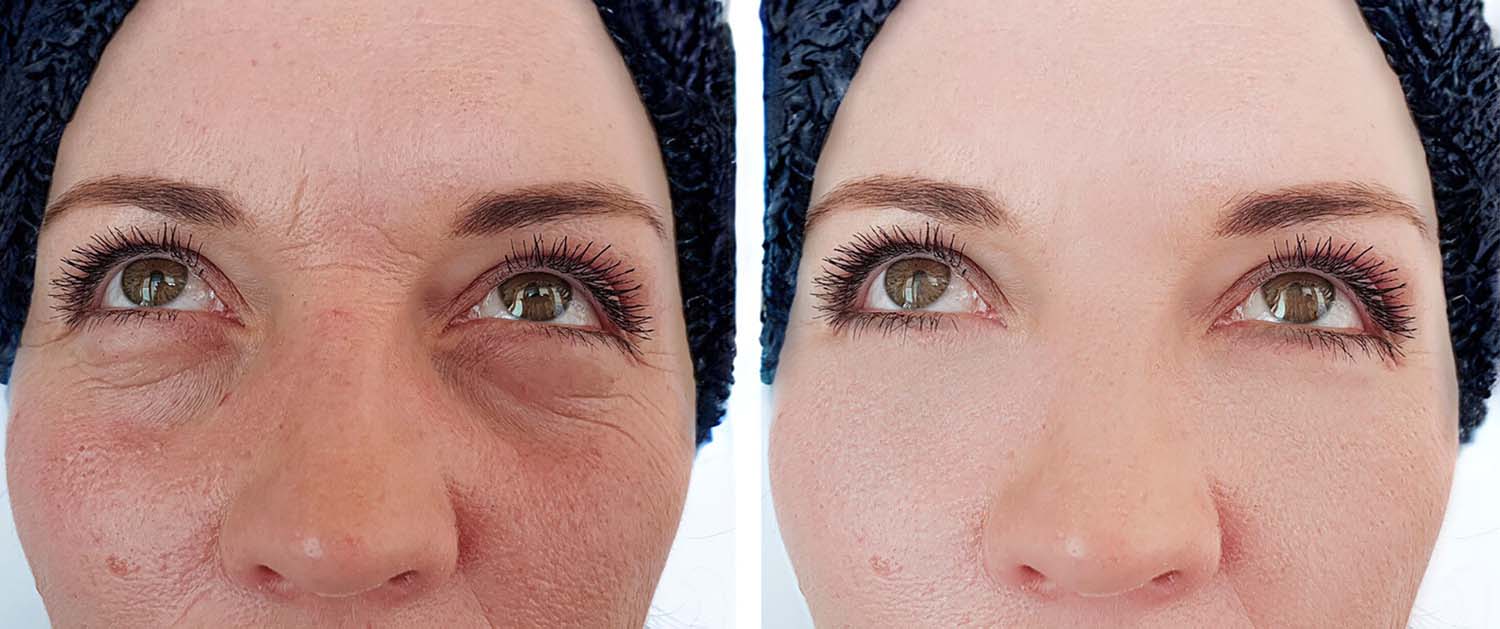
What filler migration is
Hyaluronic acid dermal filler is a gel. Once placed, it is held in position by the tissue around it rather than fixed to anything.
In most areas of the face that is enough. Under the eye it is a finer margin. The skin is thin, the tissue planes of the periorbital area are loose, and there is a natural boundary called the orbicularis retaining ligament that product can pass beneath or accumulate against. When filler moves out of the pocket it was put in, or spreads more widely than intended, that is migration, and it usually reflects what happened at the point of filler placement rather than anything the patient did afterwards.
It is not the same as filler simply lasting a long time. Well-placed under-eye filler can stay in position for years and look correct throughout. Migration is a change in where the product sits, not how long it survives.
Filler migration signs: how to tell if yours has moved
The signs are usually gradual, which is why they are often missed or put down to tiredness and ageing:
- Puffiness that was not there initially, particularly noticeable on waking and slow to settle during the day
- A bluish or grey cast, known as the Tyndall effect, caused by light scattering through product sitting too close to the skin surface
- A visible ridge or shelf, often along the lower orbital rim or extending onto the upper cheek
- Heaviness in the lower lid that makes the eye look smaller or more hooded
- Loss of symmetry over time, where the two sides have settled differently
One useful test: compare a photograph taken two weeks after treatment with one taken now. Migration shows up in that comparison far more clearly than in the mirror, because the change happened slowly enough that you adjusted to it.
Why under-eye filler migrates
Several things contribute, and they usually combine rather than acting alone.
Too much product. The single most common cause. The area needs very small volumes, and the correction people want often exceeds what the tissue can hold in place. Excess has to go somewhere.
Product placement that is too superficial. Filler sitting close to the surface rather than deep against bone is more visible, more likely to attract water, and more likely to move. It is also what produces the Tyndall effect.
The wrong filler product. Thicker formulations designed for cheeks or jawline hold their shape well in those areas and behave badly under the eye. Product choice matters as much as volume, and something chosen for structure elsewhere is not a product for this area.
Treating the wrong problem. Not all under-eye concerns are volume concerns. Filler placed to correct something it cannot correct tends to be over-placed in the attempt. If the issue is dark circles caused by pigment, or eye bags caused by fat prolapse, adding volume will not fix it, and adding more will not fix it either.
Change in the face around it. Product placed correctly at 30 sits in a face that keeps changing. As midface support reduces and skin quality shifts, filler that was well supported can become less so.
How long migration takes to appear
There is no fixed timeline, which is part of the problem.
Some changes are visible within a few months. More often the shift is slow enough to go unnoticed for a year or more, and people become aware of it only when they see a photograph, or when a practitioner points out product that is already there.
That delay matters for two reasons. Patients rarely connect the change back to the treatment, and repeat dermal filler injections are sometimes layered on top of product that has not gone anywhere, which compounds the problem rather than correcting it.
What can be done about it
This is the part most articles on under-eye filler gone wrong leave out.
Any dermal filler treatment using hyaluronic acid is reversible, and it stays reversible. An enzyme called hyaluronidase breaks the product down, and it works on filler that has been in place for years just as it works on filler placed last month. Migration is correctable.
Dissolving is usually done conservatively and sometimes across more than one appointment, because the aim is to remove what has moved without flattening the area entirely. Post-treatment care afterwards is straightforward, but the area does need time: tissue that has been supported by filler takes a few weeks to settle once that support is gone, and it can look worse before it looks better.
After dissolving, the honest options are to leave the area alone, to treat skin quality rather than volume, or to start again conservatively once everything has settled. Where tear trough filler in London is still the right answer, it is planned from scratch rather than resumed, and which of those routes makes sense depends on what the area looked like before any filler was placed.
If you have had under-eye filler elsewhere and are unsure whether it has migrated, that is a reasonable reason for an initial consultation on its own. You do not need to commit to further treatment to find out where you stand.
How migration is avoided in the first place
Prevention is mostly restraint and patient assessment rather than any particular trick of technique.
Assessment comes first, because the treatments that migrate worst are the ones that should not have happened. Evaluating midface support, skin thickness and pigmentation, the presence of fat prolapse, and whether the concern is volume at all decides more than anything that follows, which is why treatment planning should take longer than the treatment. That assessment is the first part of any tear trough filler treatment in London at PHI Clinic, and it is where most of the decisions get made.
Where treatment is appropriate, our practitioners plan under-eye filler injections around facial anatomy rather than around a standard protocol. Injecting techniques matter here in a way they do not elsewhere: a cannula rather than a needle, product placed deep against bone, small volumes with the option to add at a review. Respecting anatomical boundaries such as the orbicularis retaining ligament is what keeps product where it was put.
Injector techniques vary widely across the industry, and the under-eye is where that variation shows most. Conservative treatment is not caution for its own sake. Placing less means there is less to move, and a result that looks slightly understated at two weeks is usually the one that still looks right at two years.
Other under-eye filler complications
Migration is the most common delayed problem, but it is not the only risk worth knowing about.
Vascular occlusion, where filler blocks a blood vessel, is rare and serious. It is the reason this area belongs with an injector who understands the anatomy and keeps hyaluronidase to hand. Patient safety here rests less on equipment than on assessment and on knowing when to stop. Infection, prolonged bruising, and fine lines appearing more pronounced after treatment are all uncommon but possible.
Any of these are worth raising with the clinic that treated you rather than leaving them.
Tear trough filler at PHI Clinic
Under-eye filler is unforgiving rather than unsafe. As a cosmetic treatment it has a long track record when it is performed with proper assessment and conservative volumes. Performed without either, it produces exactly the results that send people searching for what has gone wrong.
At PHI Clinic the under-eye area is approached with restraint, and we will say when filler is not the answer rather than treat and hope.
If you are considering tear trough filler at our London clinic, or you have had it elsewhere and are concerned about how it has settled, book a consultation and one of our practitioners will assess the area and tell you honestly what your options are.